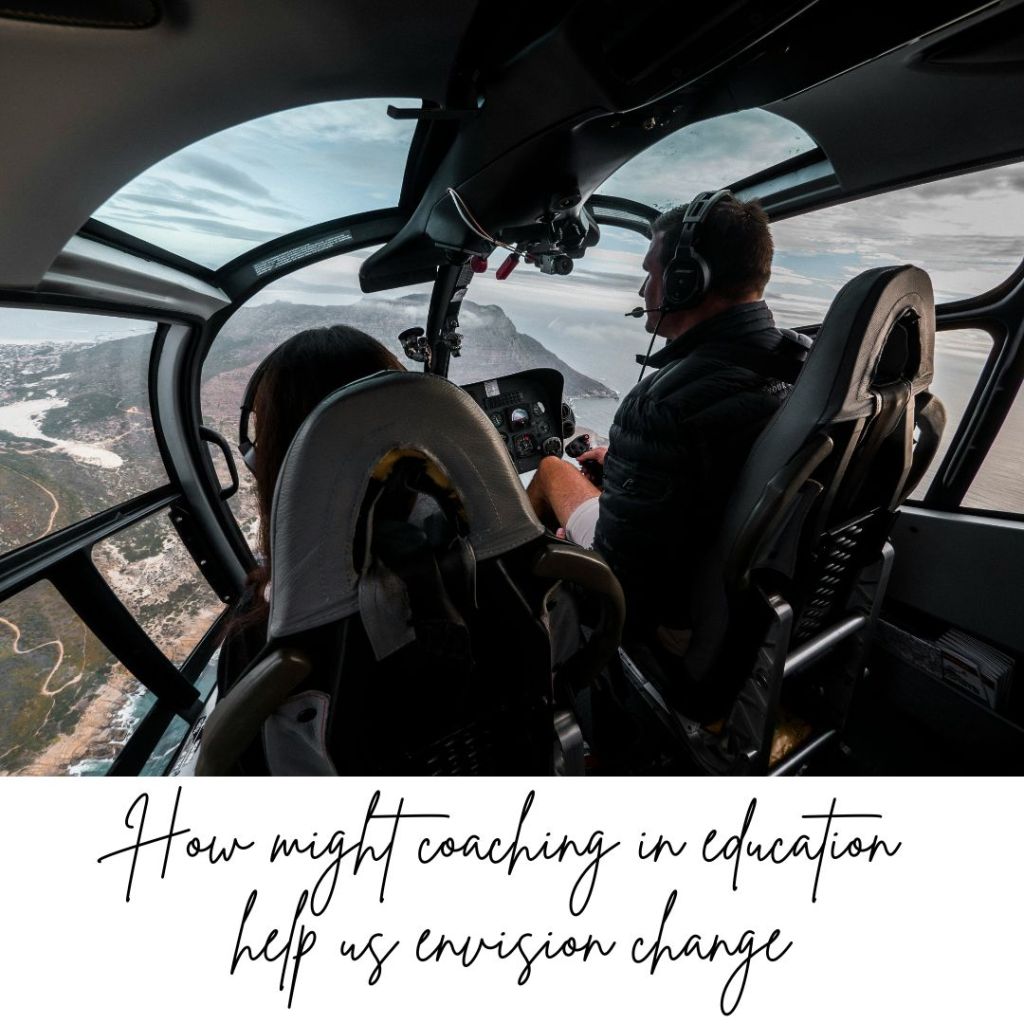
Earlier this week, I spoke with Chris Sibbald, a fellow coach, who was musing on the idea of working backwards from a desired future—a ‘future-back’ approach. This resonated with me as an invitation to envision what an ideal educational future might look like and to consider the steps that could bring it closer to reality. Gaining clarity about our vision is essential for understanding our work, recognising our challenges, and uncovering our potential. The International Coaching Federation (ICF) calls this evoking awareness—encouraging clients to deepen their insights and broaden their perspectives. I see this as especially useful in educational contexts, where coaches can help educators clarify their aspirations, identify meaningful goals, and consider pathways toward those goals that might not be immediately apparent. A future-back approach allows us to look beyond immediate challenges and instead focus on cultivating a larger, more purposeful vision.
Another fellow coach, Shawn Michael, suggests considering changing our subconscious blueprint, adding another layer to this visioning process. A blueprint suggests that we can create a tangible, adaptable roadmap to guide our efforts (or, the blueprint we have might, in fact, hinder us). This idea has begun to flow into my own coaching conversations and reflections—if we are open to developing a new blueprint, we might just give ourselves the space to “dream,” constructing an aspirational yet grounded path forward.
Reflecting further, I thought how the Overton window might fit into this—a concept developed by policy analyst Joseph Overton, which frames change as a gradual widening (or narrowing) of what is considered possible. Could this apply to education as well? Rather than implementing an idea and sticking to it regardless of how it evolves—which can sometimes lead to unintended consequences, or as Iain Henderson describes, “lethal mutations”—the Overton window encourages us to recognise how ideas evolve and gain acceptance gradually and can use this to guide our reflections. Consider the initiatives in education that seemed promising at first but have evolved over time into something that may no longer serve the children and society as intended. What examples come to mind? How have these shifts in what’s considered “acceptable” impacted educational practices today?
This isn’t to say that future-back thinking or incremental change are the only ways forward. Education is a complex system, and the challenges we face—for example, the challenges climate change poses, managing mental health, or integrating technology—resist simple cause-and-effect solutions. In this sense, coaching may be less about directly controlling outcomes and more about fostering adaptability and resilience through reflective practice. Perhaps the role of educators isn’t so much about controlling change or “having the answers” but rather about nurturing and safeguarding the complexity within our systems. A blueprint could help us stay focused while allowing flexibility.
Ultimately, coaching could serve as a powerful tool for envisioning meaningful change, not by pushing immediate fixes but by creating space for educators to think beyond current limitat
 Candida Javaid Coaching & Mentoring