Our morning coffee chats are a cherished part of our daily routine. It’s when my husband, Kassim Javaid, and I take the time to reflect on what’s been going on in our minds and share our thoughts. This morning, he was telling me about an AI research project he’d been working on. The findings were surprising, yet not entirely so—if you take a moment to think about it, they make sense. But what really stayed with me wasn’t the findings themselves. It was something he said that truly resonated:
“AI is a component of the ecosystem, it is not the ecosystem.”
That statement immediately clicked for me, and I realised we were completely in sync. Although we approach things in very different ways—he’s the evidence-based, data-driven, balanced thinker, and I tend to be more reflective, diving into books, podcasts, and ideas—this idea felt exactly right. It was just the way I had been thinking about AI, but I hadn’t quite put it into words like that before.
There’s so much talk about AI these days, and often it’s filled with fear and worry about how it might threaten our roles or change the world. While those concerns are worth thinking about, that’s not really where I want to focus. Instead, I want to explore the idea that AI is not some all-powerful force, but simply a component within a much larger ecosystem.
Thinking of AI as just one part of the bigger picture gives a sense of perspective. AI is a tool, a piece of the puzzle, and like any tool, it has a role to play. But it’s not the whole picture. The ecosystem—the environment, our society, and the way we choose to use technology—will always be shaped by human values and decisions. We can’t place all our hopes or fears on one technology, no matter how impressive it is.
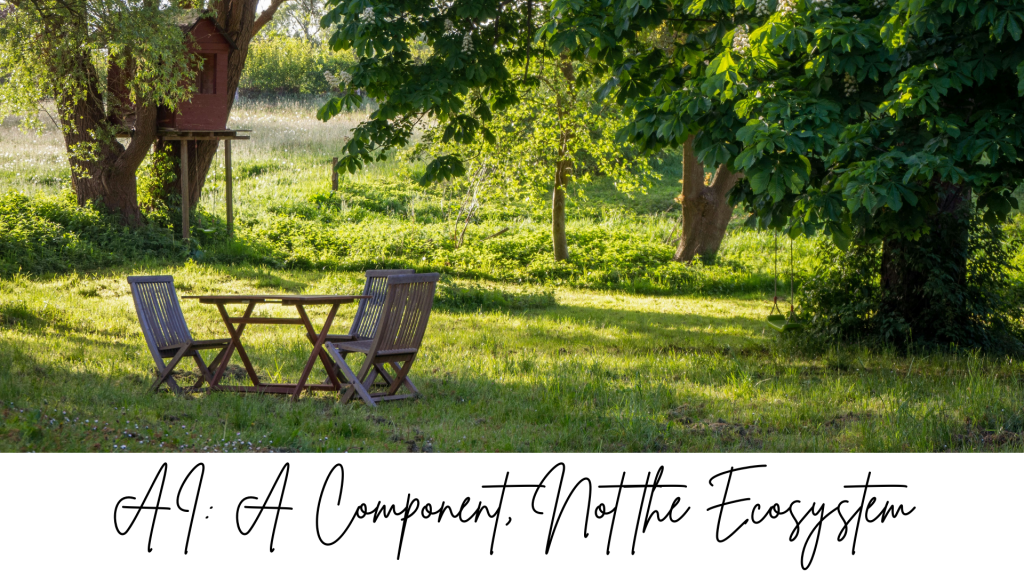
For me, this brings a sense of responsibility. If AI is a component of the ecosystem, then it’s up to us to step up and become the gardeners. We need to make space for AI to grow and evolve in a way that aligns with our shared values and goals. Just like gardeners, we need to nurture and guide the environment we’re cultivating. We need to keep an eye on what’s growing, what needs a little trimming, and what might need a helping hand along the way.
This is an invitation to get involved and take responsibility. It’s about guiding AI in a way that benefits everyone and ensuring we stay mindful of the broader ecosystem—connecting technology with people, nature, and culture in a way that’s sustainable and human-centred. It’s not about being afraid of the unknown, but rather being active participants in shaping it. We are the ones who will determine how AI fits into the world we’re building together.
Professor Peter Hawkins’ words from a recent conversation with George Warren on the The Edge of Coaching podcast resonated with me here. He shared:
“And when I first came here, I was very naïve. I thought, if I just leave the fields to rewild, we’d have a better ecology. I was so naïve. I had learned that wildflower meadows are as much a carbon sink and collecting as a woodland is, if they’re a natural wildflower meadow. But actually, to sustain a wildflower meadow, when I let it grow, the grass grew incredibly tall and patched over, and it became an ecological desert. Right? So I’ve had to learn. And I think that image of what the meadow has taught me about what it needs. And I’ve had to give up trying to be the expert gardener or the fledgling hobby farmer, and now walk out into the garden and ask the garden, what does it need? What’s it asking for me? To really attend to what plants need water, what plants are feeding or need pruning.”
This process of learning and listening to what the environment needs mirrors our approach to AI. We must ask what it requires and how we, as the gardeners, can nurture it to ensure it thrives within the greater ecosystem. How the ecosystem on a whole can thrive with our input.
So, as we move forward, let’s remember that AI is not the ecosystem. It’s just one part of it. And it’s up to us to be the gardeners, tending to the bigger picture with care, intention, and a focus on what really matters.
 Candida Javaid Coaching & Mentoring