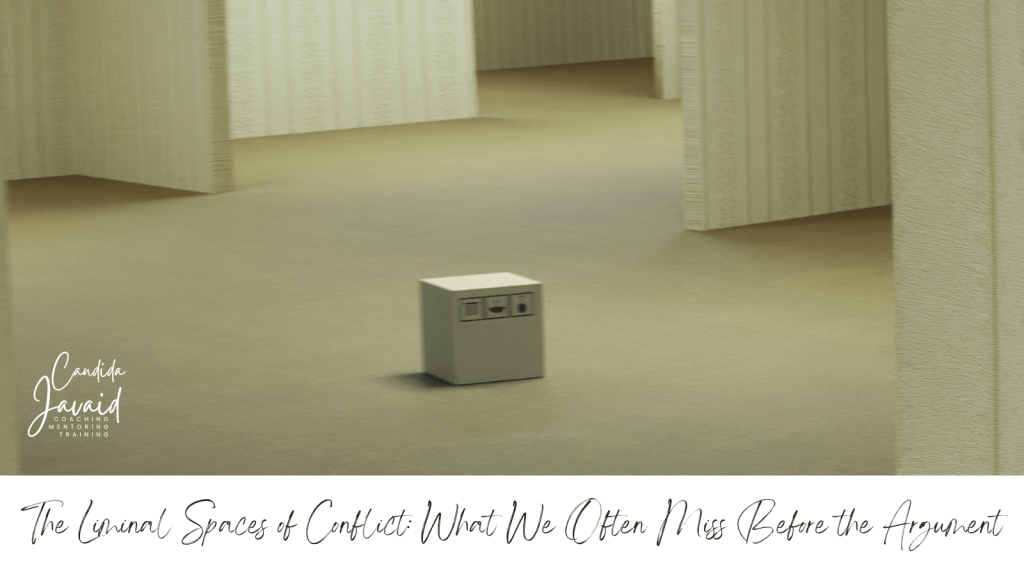
Photo by Vadim Bogulov on Unsplash
Some ideas have a way of taking root and refusing to let go. For me, one of those came from an episode of the Deeper Thinking Podcast: “Conflict rarely announces itself as conflict. It arrives as noise.” Holly, known as “the digital narrator,” shared this thought. Her way of framing human behaviour often makes me pause, and sometimes I carry those reflections into my work with students and coaching groups.
Recently, in our Coaching in Action group, we explored Karpman’s Drama Triangle (the familiar dance of villain, hero, and victim roles) that tends to shape our conflicts. As we unpacked a real-life situation someone brought from work, something interesting came into focus. We noticed that conflict does not live neatly inside any of those roles; it often emerges in the liminal spaces between them.
These are the subtle, grey-zone moments, filled with half-sensed tensions, small hesitations, and unspoken assumptions. It is in these spaces that our perceptions, desires, and automatic reactions start to form, long before we label what is happening as “conflict.”
The Whisper Before the Argument
Our biggest insight from that conversation was simple but powerful: conflict rarely starts with a loud argument. That flashpoint is just the moment we can no longer ignore what has been brewing underneath. Usually, it begins as something much quieter, like a bodily signal, a shift in tone, a lingering feeling of unease, or a thought that does not sit quite right.
If we look back after the occurrence of conflict, we can often trace the threads—the tiny signals and recurrent reactions that contributed to the tension. Or we might struggle, particularly if our blind spots hinder us from noticing. Here lies the opportunity: when we catch these early moments, we have a chance to intervene consciously rather than be swept into the familiar roles of the triangle.
Practising Presence “Above the Line”
In coaching, we often talk about staying above the line, which is a state of awareness that keeps us grounded, attentive, and open. It is not about perfection but about practice. Being “above the line” means we:
- Observe body and mind for signs of tension or distraction
- Notice when desire or judgment narrows perception
- Choose to respond consciously instead of reacting automatically
Of course, this does not make us immune to conflict. Blind spots will still catch us, and emotions will still arise. But the practice itself, returning again and again to awareness, changes how interactions unfold. It helps us stay curious, compassionate, and connected, even when conversations turn difficult.
Paying Attention to the Process
Conflict is not a single event; it is a process that unfolds over time. By learning to listen to the murmurs, we can influence how it develops. In those liminal spaces where tension begins to grow, presence can be the most transformative tool we have.
I am deeply grateful to our small group of fellow thinkers who continue to explore these edges together. If this kind of reflective conversation resonates with you, we would love to have you join us.
We meet weekly in Begbroke (just five minutes from Blenheim, near Oxford) on Tuesday evenings, where there is always room for another curious mind. If you want to find out more, click here.
It would be lovely to have you.
Get in touch to find out more
Interested in joining our “Coaching in Action” Group?
 Candida Javaid Coaching & Mentoring