
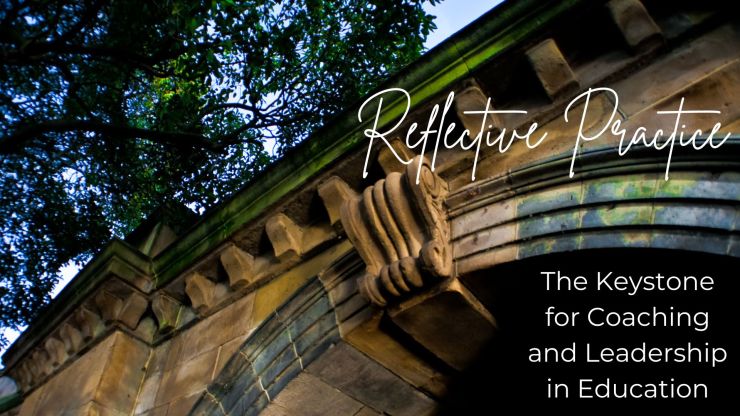
I’ve been reflecting on the role of coaching in education. While coaching individual teachers and headteachers, and even embedding a coaching culture within schools, is valuable, what if we went further? What if we viewed reflective practice as the keystone of school leadership? A keystone, the central stone in an arch, holds everything else in place. In the same way, reflective practice could stabilise and support the entire coaching and leadership framework, ensuring that all other aspects—personal growth, team coaching, and collaboration—can thrive.
Reflective practice would bind the school’s structure by creating space for everyone—teachers, students, and leaders—to engage thoughtfully with their experiences. With this foundation, coaching in all its forms could naturally emerge, from one-to-one coaching to team and organisational coaching, fostering collaboration and growth across the educational ecosystem. What if all these varied forms of coaching could find their place, underpinned by reflective practice? Without this keystone of reflection, imbalance and conflict would inevitably arise because people need to feel seen, heard, and valued. When this doesn’t happen, disengagement or withdrawal often follows.
Professor Peter HAWKINS recently talked about this idea in his masterclass with Coaches Rising, framing it as part of a New Coaching Paradigm. He highlighted that:
- You are never just coaching an individual but coaching with and through them.
- The coachee is not simply your client but your coaching partner, and it is the joint purpose that creates the partnership, not just the partners themselves.
- The team dynamic, organisational culture, the wider community, and even the ecology are not external factors to discuss but are present in the room during coaching.
- Transformational coaching begins when we move beyond what the coachee wants, to consider what their world needs from them.
- All significant learning and transformation happen at the learning edge, where neither the coach nor the coachee has the answer, but both recognise the world is demanding a new response.
This brings me to Marshall Goldsmith‘s perspective on reflective practice, a cornerstone of his teachings. He views it as a process of self-examination that deepens our understanding of behaviours, decisions, and actions. As Goldsmith explains, reflective practice can be one of the best professional development tools available, precisely because it is free. It doesn’t require financial investment, but it demands commitment, mental effort, and emotional resilience. His Daily Questions process, which focuses on asking active questions like “Did I do my best to build positive relationships today?” shifts the focus to what we can control and encourages continuous improvement.
He reminds us that despite being free, the challenge lies in its difficulty: regularity, self-awareness, and a willingness to confront uncomfortable truths. But as Goldsmith suggests, this commitment can lead to profound personal and professional growth.
The increasingly varied coaching landscape—with systemic, team, and ecological coaching—is rich with possibilities. But perhaps it’s not the coaching itself we need to focus on. What if reflective practice, facilitated through coaching, is the real keystone we need to unlock growth and collaboration in schools? Reflective practice could provide the space for schools to become dynamic, thinking organisations where coaching adapts to meet the needs of both the individuals and the system they operate within.
A side note: while I’ve consulted Marshall Goldsmith AI on some of these ideas), I also highly recommend Dave Stachowiak‘s Coaching for Leaders podcast, in this case, episode #696, for further insights into Marshall Goldsmith’s thinking.
How do we, as coaches, begin this shift? By creating reflective spaces that encourage genuine inquiry, we can help unlock the rich potential of coaching to bring about meaningful change across the entire educational system.

