
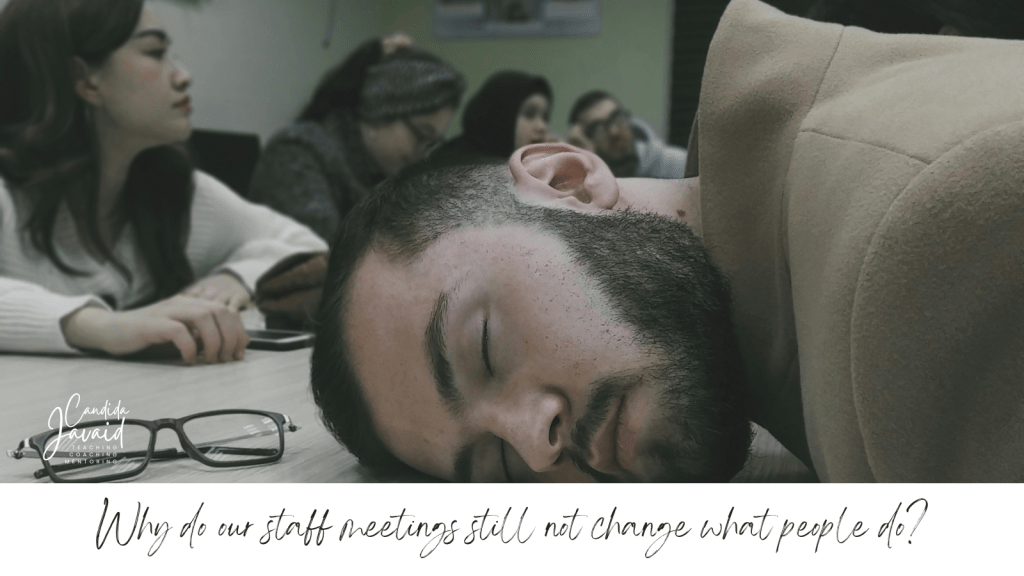
Photo by Abdul-Basit Melik on Unsplash
Some meetings really matter. Staff briefings are crucial. And yet, when I am in one, and I look around the room, I wonder how engaged people really are. In an ideal world, people would simply act on what they are told, engage during the meeting and wow, everything just flows. But I hear many leaders say that this is not what happens. And even when there is a sense that the issue might sit within how those meetings and briefings are ‘done’ and that they are not as effective as they could be, the pattern often continues. Meeting after meeting. Another agenda is created. More effort goes into planning of those agendas. Sometimes a bit of fun is added or the leader might read a book on how to do meetings… If I am honest, where I am sitting, it can feel very much like bread and games, and this is where I find myself switching off.
I am no longer a school leader, but I remember also finding this difficult. Adding kindness, biscuits, or shortening the agenda did not really do anything. So what is the alternative? Where are the examples that genuinely help? We often turn to books and try out a new idea, and there is value in that but it is not just about tools, it’s about a way of being.
As some of you know, I have been playing with the idea of dialogue for a while now. Dialogue is not simply a back and forth between two people. It is something that happens through words, where thinking develops in the space between us. It allows something new to emerge that none of us had thought of before. It is not about a leader placing ideas into people’s heads. Yet many meetings still operate in exactly that way.
We are all meaning-making individuals. We interpret what we hear through our own lens, yet in meetings we are often expected to switch that off. I often hear that there is no time. It feels true, and yet it also keeps us stuck. The system is busy, and trying to take shortcuts does not solve the problem.
Perhaps this is less about doing something new and more about how we are being together. Do I really value the thinking of others, or am I judging and becoming impatient with their contributions? Even that judgement is just a thought. Not one we need to hold on to.
So what might we do instead? How might we begin to shift this? One possibility is to work with a team facilitator or team coach. Not because it is essential, but because it can help. It can be hard to see the system we are in when we are part of it. A facilitator can create the conditions for people to think together in a different way.
There are approaches that support this. Liberating Structures, team coaching practices, and learning from how other teams work can open up new ways of thinking. And that feels like the point. To generate fresh thinking together.
When time with staff is limited and valuable, how do we want to use it? To pass on instructions that may or may not land, or to create something that did not exist before?
As mentioned, you do not need a facilitator or team coach. But they can make it easier. They can help create the space to think together, so that you and your team can move towards the kind of school you would like it to be.

